Hall Art Foundation
Skip to main content
  • Menu
  • About
  • Exhibitions
  • Locations
    • Derneburg
    • Vermont
    • MASS MoCA
  • Loan Program
  • Collection
  • Media
    • Publications
    • Videos
  • News
  • Contact
  • BUY TICKETS
  • EN
  • DE
Menu
  • Menu
  • Menu
  • BUY TICKETS
  • EN
  • DE
  • Current
  • Past

Georg Baselitz: Ongoing

Upcoming exhibition
Kunstmuseum Schloss Derneburg
  • Information
  • Installation Views
  • Artworks
  • Artist
  • INFORMATION

    Kunstmuseum Schloss Derneburg welcomes you to a new installation in the former "sculpture studio" of Georg Baselitz. During his approximately 30-year ownership of Schloss Derneburg, Baselitz transformed a large part of the castle into studio space for painting, sculpture, and printmaking. However, the former castle kitchen of the previous owners - the Münster family - was his primary sculpture studio until the "New Studio" building was completed in 1995. Preparatory wall drawings made by Baselitz while he lived and worked in the castle are preserved and exhibited here alongside documentary photographs taken by the artist's long-time friend and former gallerist, Benjamin Katz. The diamond patterned floor and iron infrastructure which supported the weight of blocks hewn from tree trucks are prominent in Katz's photographs and are still present today.

  • Sculpture is a thing like a miracle. It is built up, decked out, made arbitrarily not as the sign of...

    Photo: Franziska Lenferink

    Sculpture is a thing like a miracle. It is built up, decked out, made arbitrarily not as the sign of thoughts but as a thing within the confines of the form. Even if a sculpture is hung from the ceiling, it remains a thing, for even blind people can see it.

    It is no corpse, it is not the envelope of something, it is more like a dead machine – one can presume the presence of a spirit in it as a partner for correspondence.

    - Georg Baselitz, ‘Skulptur’ / ‘Sculpture’, in Georg Baselitz: Recent Sculpture, Exhibition Catalogue: Gagosian Gallery, New York, 2004.
  • Baselitz's sculptural practice began in Derneburg in 1979 with the piece Modell für eine Skulptur (1979-80) - the sole work...

    Baselitz. Preliminary wall drawing for Modell für eine Skulptur, ca. 1989
    Kunstmuseum Schloss Derneburg. Photo: Roman März

    Baselitz's sculptural practice began in Derneburg in 1979 with the piece Modell für eine Skulptur (1979-80) - the sole work representing Baselitz in the German Pavilion of the 1980 Venice Biennale. Preliminary sketches for this sculpture are preserved here among others, and show a reclining figure seated on the floor with one arm provocatively extended. The composition resembles African Lobi sculptures from Baselitz's personal collection from which he took inspiration. The artist's sculptural aesthetic is characterized by the rugged tools he employed, including chisels, axes, and chainsaws. Baselitz's practice of purposely maintaining jagged and unrefined edges began with Modell für eine Skulptur , which is composed from roughly hewn blocks of limewood and painted with tempera. Baselitz explained, "In sculpture, using the saw is an aggressive process which is the equivalent of drawing. By working in wood, I want to avoid all manual dexterity, all artistic elegance, everything to do with construction. I don't want to construct anything." [1]
  • Baselitz continued employing linden and ash trees indigenous to Europe for his sculptures, as their wide bases allowed for single...
    Baselitz in the Atelier. Installation view, Kunstmuseum Schloss Derneburg. Photo: Roman März
    Baselitz continued employing linden and ash trees indigenous to Europe for his sculptures, as their wide bases allowed for single block compositions and the species grew prominently around the castle grounds. Linden trees maintain a dexterity ideal for fine sculpture but are also prominent within German folk traditions and culture. In Goethe's The Sorrows of Young Werther it embodies the epitome of idyll. In the epos Nibelungenlied, its leaves symbolize vulnerability. After bathing in the dragon's blood, Siegfried the dragon slayer is invulnerable except for a spot on his back, which is covered by a linden leaf during the bath and ultimately becomes his nemesis. Between 1997 and 2003 Baselitz took an unprecedented break from sculptural production due to health issues preventing the artist from physical exertions working in wood. When he returned to sculpture in 2003, he began with forms which could be interpreted as self-portraiture, including the medium format Pace Piece (2003) also cut from linden. The sculpture is currently installed in the exhibition Baselitz im Atelier , and resembles the shoes and shorts Baselitz often wore in the studio. The foreshortened leg painted on with oil also resembles Baselitz's mentor, the painter Edward Munch, whose infamous portrait in his studio is abruptly truncated at the artist's knees.
  • Thirty years after making Modell für eine Skulptur, Baselitz completed the monumental sculpture, Dunklung Nachtung Amung Ding (2009). The seated...

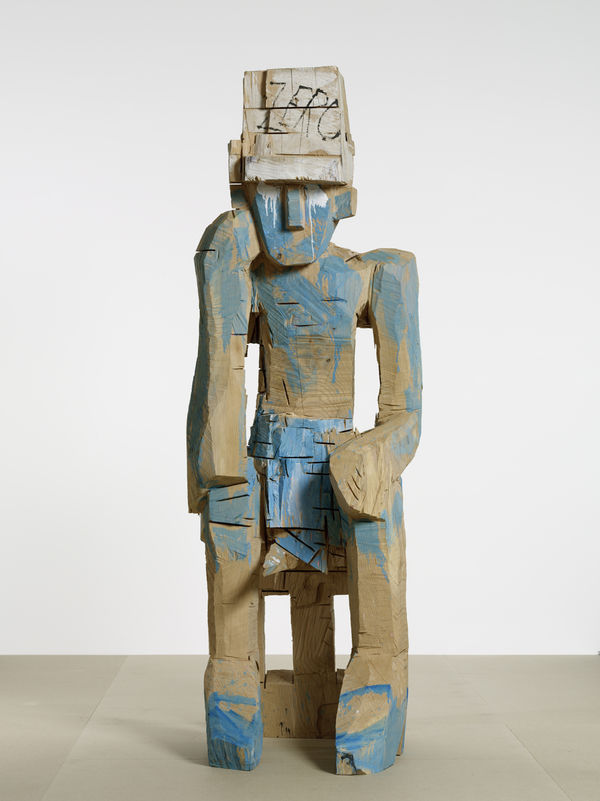
    Georg Baselitz. Dunklung Nachtung Amung Ding, 2009. Hall Collection

    Thirty years after making Modell für eine Skulptur, Baselitz completed the monumental sculpture, Dunklung Nachtung Amung Ding (2009). The seated figure wears a white cap that resembles Baselitz's studio hat from this period, which the artist first included e.g. in an earlier sculpture titled Meine neue Mütze (2003). Adapted to possibly also resemble a wartime pimpf style with shortened brim, Baselitz then added to the cap the painted inscription ZERO, suggesting both the starting point for inspiration and a reference to Stunde Null (zero-hour, midnight on 8 May 1945). The hulking figure mirrors Rodin's The Thinker (1904) in overall form but not in its precise execution, with splattered and uneven blue paint perhaps interrupting a moment of contemplation it refers to the much older sculptural tradition of the "Pensive Christ" which is still popular in especially Eastern European Folk Art (e.g. in Poland as 'Chrystus Frasobliwy'). The grain of the cedar wood is conspicuous and acts as an additional visual layer, both within the produced rough and jagged edges as well as the inherent cracks within the material.
  • Complimenting Dunklung Nachtung Amung Ding, the bronze sculpture Dresdner Frauen - Elke (1989/2023) is presented in Derneburg where Baselitz originally...

    Georg Baselitz. Dresdner Frauen - Elke, 1989/2023. Hall Collection

    Complimenting Dunklung Nachtung Amung Ding, the bronze sculpture Dresdner Frauen - Elke (1989/2023) is presented in Derneburg where Baselitz originally sculpted the Dresdner Frauen series. The exploration of Dresden's post war narrative by the artist, who grew up 60km outside of the city, led to the creation of the wooden sculpture group in 1989. The widespread destruction of the historic city by British and US air raids in February 1945 targeted one of the last intact military bases, an important transportation hub, as well as industrial sites, and resulted in the destruction of the city's center, its iconic buildings, as well as its population. The Dresdner Frauen are Baselitz's homage to the so-called "Trümmerfrauen" (rubble women), who are credited in post war narrative with a significant part in the clearing and reconstruction of destroyed German cities. Like the city's past, which is characterized by violent interventions in the cityscape, Baselitz's portrait named for his wife Elke who was born and raised in Dresden, (yet being a child in the 1940s) is characterized by inverted facial features made with rough markings and demonstrates the raw approach to his sculpture making.
  • The angular forms of Baselitz's roughly hewn sculptures translate well when cast, an example of which is installed on castle...

    Baselitz. Sing Sang Zero, 2012. Installation view, Kunstmuseum Schloss Derneburg. Photo: Roman März

    The angular forms of Baselitz's roughly hewn sculptures translate well when cast, an example of which is installed on castle grounds. Titled Sing Sang Zero (2012), the bronze sculpture in matte black depicts the artist again with studio cap, here linking arms with his wife, Elke. This behavioral form of linked limbs was something that Baselitz recognized as nonexistent within sculptural tradition. The monumental pair share awkward proportions, a widened stance, and horizontal cuts in their limbs and torso that emphasize the physical nature of their making. The work's prominent placement at the museum's entrance honors the couple for whom the castle was home for thirty years.


    [1] Georg Baselitz [Exhibition catalogue]. New York: Guggenheim Museum, 1995: p. 100.

  • Installation Views
  • Artworks
    • Georg Baselitz, Dunklung Nachtung Amung Ding, 2009
      Georg Baselitz, Dunklung Nachtung Amung Ding, 2009
      View more details
    • Georg Baselitz, Dresdner Frauen - Elke, 1989/2023
      Georg Baselitz, Dresdner Frauen - Elke, 1989/2023
      View more details
    • Georg Baselitz, Dresdner Frauen - Die Elbe, 1990/2023
      Georg Baselitz, Dresdner Frauen - Die Elbe, 1990/2023
      View more details
  • Artist

    • Georg Baselitz
      Artists

      Georg Baselitz

  • Installation views: Roman März

HALL ART FOUNDATION

Reading, Vermont

Visit

Tickets

KUNSTMUSEUM SCHLOSS Derneburg

Derneburg, Germany

Visit

Tickets

Newsletter

HALL ART FOUNDATION

Reading, Vermont

Visit | Tickets


KUNSTMUSEUM SCHLOSS Derneburg

Derneburg, Germany

Visit | Tickets


Newsletter

Facebook, opens in a new tab.
Instagram, opens in a new tab.
Privacy Policy
Manage cookies
Unless otherwise noted, illustrated works belong to Andy and Christine Hall, HCI, or the Hall Art Foundation.
Copyright © 2026 Hall Art Foundation
Site by Artlogic

This website uses cookies

This site uses cookies to help make it more useful to you. Please contact us to find out more about our Cookie Policy.

Manage cookies
Reject non essential
Accept

Cookie preferences

Check the boxes for the cookie categories you allow our site to use

Cookie options
Required for the website to function and cannot be disabled.
Improve your experience on the website by storing choices you make about how it should function.
Allow us to collect anonymous usage data in order to improve the experience on our website.
Allow us to identify our visitors so that we can offer personalised, targeted marketing.
Save preferences
Close

Join our mailing list

Signup

* denotes required fields

We will process the personal data you have supplied to communicate with you in accordance with our Privacy Policy. You can unsubscribe or change your preferences at any time by clicking the link in our emails.