
Photo: Tara Wray

Photo: Tara Wray

Photo: Tara Wray

Photo: Tara Wray

Photo: Tara Wray

Photo: Tara Wray

Photo: Tara Wray

Photo: Tara Wray

Photo: Tara Wray
Photo: Tara Wray

Photo: Tara Wray

Photo: Tara Wray

Photo: Tara Wray

Photo: Tara Wray

Photo: Tara Wray

Photo: Tara Wray

Photo: Tara Wray
Robert Indiana
Base footprint: 74 x 38 in. (188 x 96 cm)
Further images
-
(View a larger image of thumbnail 1
)

-
(View a larger image of thumbnail 2
)

-
(View a larger image of thumbnail 3
)

-
(View a larger image of thumbnail 4
)

-
(View a larger image of thumbnail 5
)

-
(View a larger image of thumbnail 6
)

-
(View a larger image of thumbnail 7
)

-
(View a larger image of thumbnail 8
)

-
(View a larger image of thumbnail 9
)

-
(View a larger image of thumbnail 10
)

-
(View a larger image of thumbnail 11
)
-
(View a larger image of thumbnail 12
)

-
(View a larger image of thumbnail 13
)

-
(View a larger image of thumbnail 14
)

-
(View a larger image of thumbnail 15
)

-
(View a larger image of thumbnail 16
)

-
(View a larger image of thumbnail 17
)

-
(View a larger image of thumbnail 18
)


A central figure of American Pop Art, Robert Indiana (1928-2018) is known for transforming ordinary symbols, words, and numbers from popular culture into bold, iconic paintings, prints and sculptures. Emerging in the 1960s, his work often combines typography with deeper social and political themes, drawing on the visual language of advertising and road signs. Indiana's use of strong colors, hard edges, and simple forms makes his art immediately recognizable, while his academic exploration of language and numerals reflects broader questions about identity, communication, and American culture. He is perhaps best known for his LOVE series, which has become one of the most iconic and widely reproduced images in contemporary art.
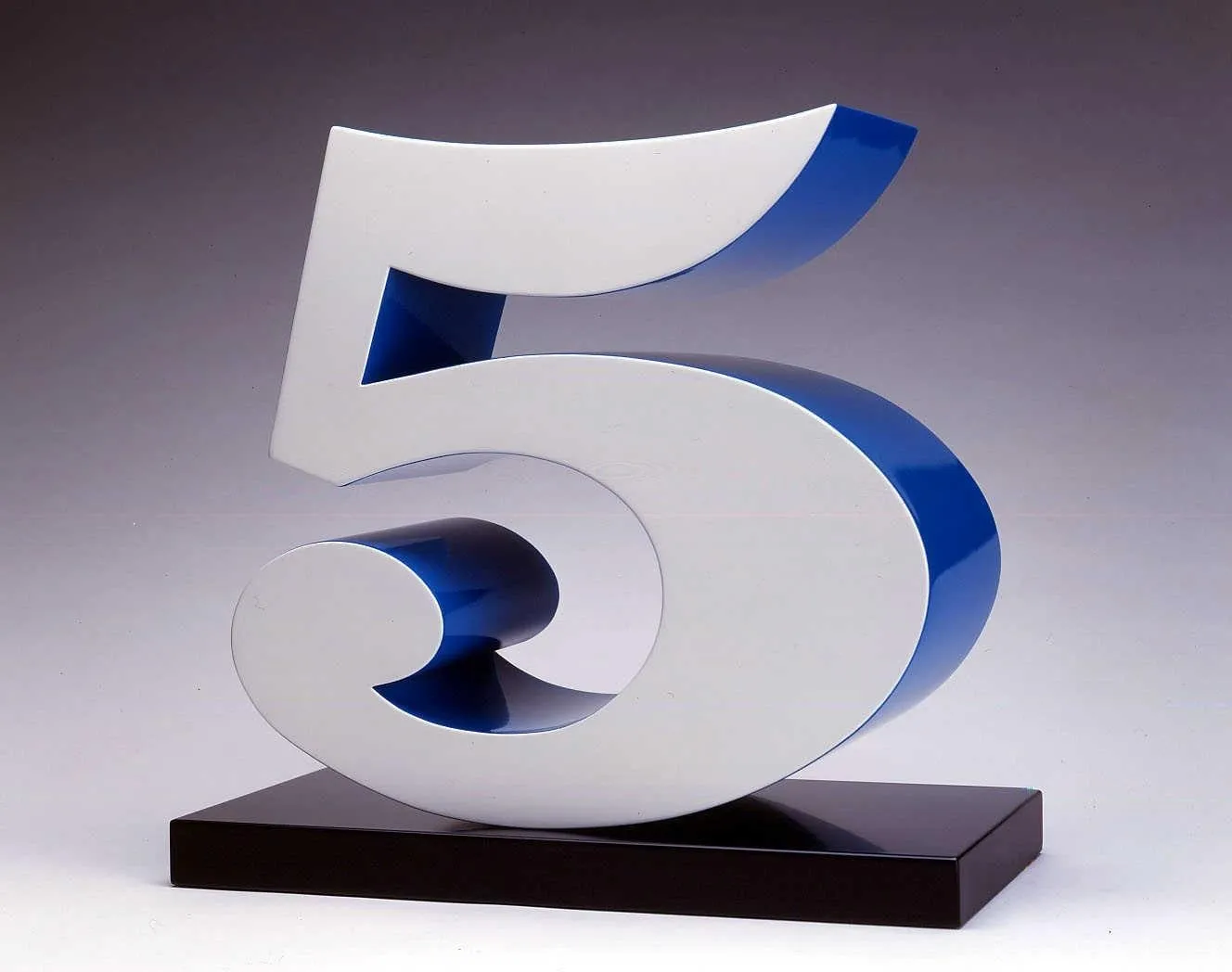
Five exemplifies Indiana's enduring attraction to numerical imagery, its symbolic potential and its personal significance. Indiana was adopted at a young age by an itinerant couple with few resources who moved frequently. He often shared that he spent a great deal of time in cars gazing at highway route numbers and lived at twenty-one addresses by the age of seventeen. The series, One Through Zero (The Ten Numbers), was originally inspired by a 19th century print depicting the stages of man's life from cradle to grave. In this work, the number five symbolizes the "pre-prime of life" as the relative midpoint between the number one representing birth and the number zero signifying death. The blue and white color scheme and the sleek, graphic clarity of the sculpture highlight the universality of numbers, transforming them from simple tools of counting into powerful visual icons that resonate across cultures and contexts. Indiana designed multiple series of Numbers sculptures with different scales and finishes, starting with a commission in 1980. Proportionally, the Numbers sculptures are consistently about half as deep as they are wide and tall, conveying a sense of substantial mass and strength.
Join our mailing list
* denotes required fields
We will process the personal data you have supplied to communicate with you in accordance with our Privacy Policy. You can unsubscribe or change your preferences at any time by clicking the link in our emails.