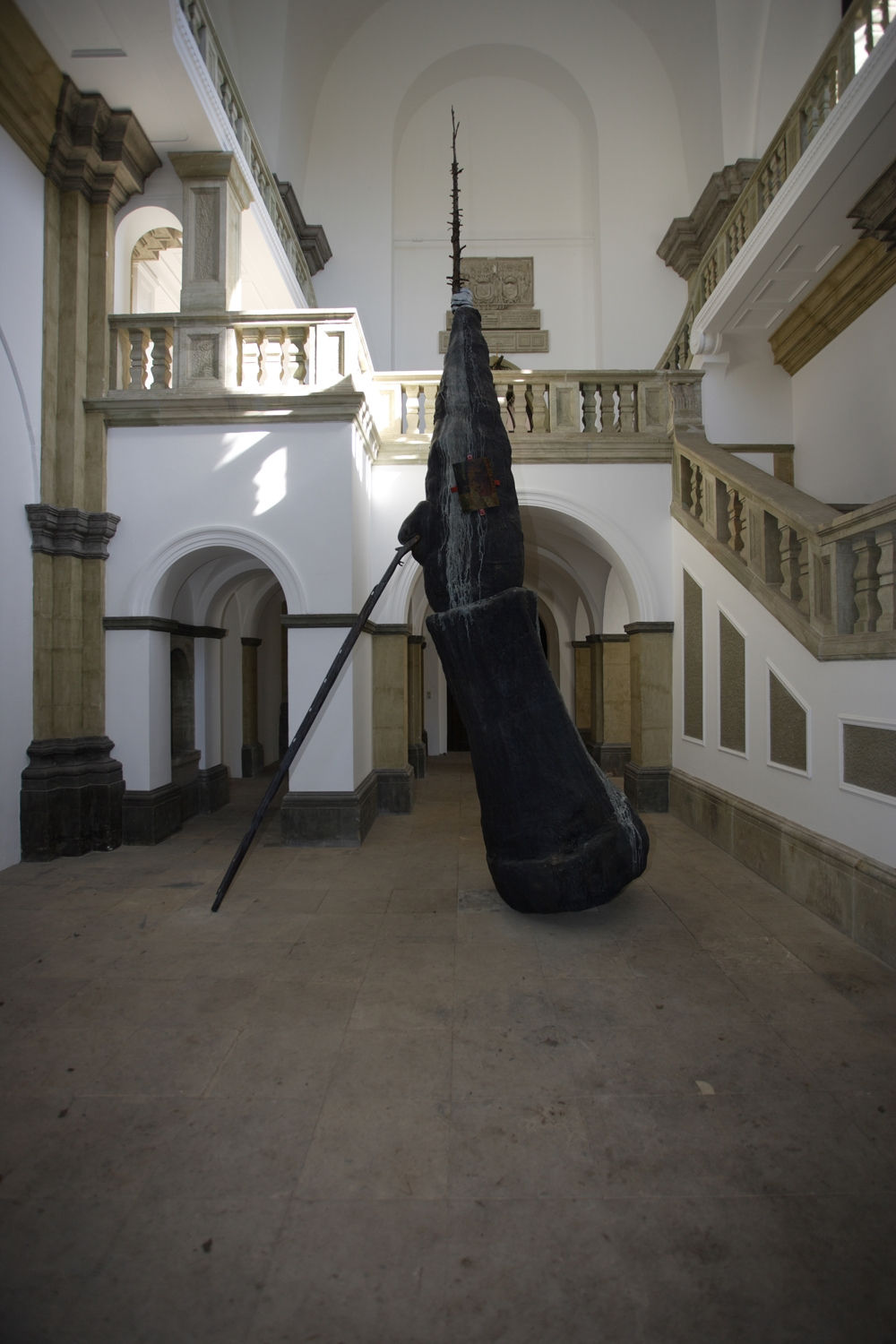
Julian Schnabel
Considered to be a figurehead in the resurgence of painting in the late 1970's, Julian Schnabel continues to create gestural and highly charged work that appropriates ancient and modern literary and cultural references, while conflating the boundary between figuration and abstraction.
The form of Schnabel's monumental bronze sculpture, Ahab (2000) is inspired by the historic cypress tree, known as Michelangelo's Cypress (Cipresso di Michelangelo) that sits in the grand cloister of the Baths of Diocletian (Terme di Diocleziano) at the Museo Nazionale Romano in Rome. The tree is said to have been planted by Michelangelo Buonarroti in 1562 and today leans at such a precarious angle that it is necessary to support it with long metal rods that extend from its center to the ground. Schnabel first saw the tree in Rome approximately 25 years ago and used its shape and support as the inspiration for Ahab, further comparing its form to the image of Christ on the cross in such paintings as Antonello da Messina's Sibiu and Antwerp Crucifixions, where Christ is depicted on a traditional wooden cross and flanked by two thieves hanging from stripped tree trunks. Here, Schnabel also draws from his earlier sculptures, borrowing and combining formal elements from his works, Gradiva (1986-1989), Self-Portrait as a Champagne Glass (1990), and Vito (1982). In Ahab, an image on rice paper covered in resin has been bolted to the center of the work's upper half. A detail from a 19th century crucifixion scene, this image depicts a red pillow and golden crown at the base of a cross. The image further includes the partially obscured words, amor misericordia (or, merciful love), which in theological and devotional contexts describes God's unconditional love paired with forgiving grace and compassion. The work's title references Captain Ahab from Herman Melville's Moby-Dick, a literary figure who has sometimes been interpreted as a dark or inverted Christ figure rebelling against a divine order.